The Independent Uganda: You get the Truth we Pay the Price


Inside the billion-dollar bazaar of mega jets and military might
NEWS ANALYSIS | IAN KATUSIIME | In the blistering desert heat, Dubai once again became the world’s grand marketplace for global aviation at the biennial Dubai Air Show held from Nov.17-21 at the Al Maktoum International Airport in the United Arab Emirates. The theme was “The Future is Here”, and from the reviews and attendance, it lived up to its billing.
What was an otherwise successful and well-attended event was doomed by an Indian Tejas jet crash on the last day that killed the pilot—casting a dark cloud on a week dominated by splendid jet formations, massive airline orders, and shows of power and prestige by the Gulf and other nations.
Emirates stole the spotlight with a thunderous announcement—an order for 65 Boeing 777s worth $38bn, reaffirming its status as the most influential long-haul airline and Boeing’s most dependable customer. The announcement took Emirates’ total order book with Boeing to 315 aircraft.
Sheikh Ahmed bin Saeed Al Maktoum, chairman and CEO of Emirates Airline and Group, said the order shows “a long-term commitment and testament to our partnership with Boeing and GE, and to U.S. aerospace.”
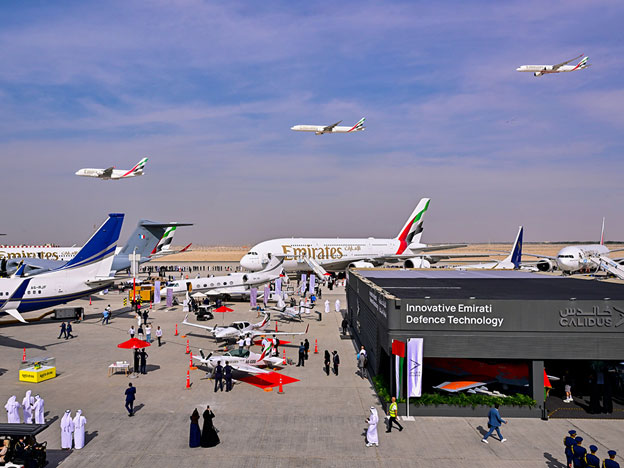
Emirates followed it up with an order for 8 Airbus A350 planes for a list price of $3.4 billion cementing it as the dominant player at the show. The A350 is the European company’s flagship aircraft, also reputed to be the most advanced plane in service. Airlines had the beloved plane on display at the Al Maktoum Airport.
The A350 is a hit with Qatar Airways, Singapore Airlines, and Cathay Pacific, among other major airlines. There were a host of aircraft on show: the B787, A380, B777, A320 and several others. Also, flydubai, a low cost airline based in Dubai, made a surprise announcement when it ordered 150 A321neo aircraft on the first day.
Airbus landed a new customer in one of the Middle East’s most ambitious and fast-growing airlines.
Two days later, flydubai ordered 75 Boeing 737 Max planes to serve its 135 destinations around the world. Both flydubai and Emirates are owned by the government of Dubai. Airbus got additional buyers from Spanish airline Air Europa for 40 A350s.
“We are proud to welcome Air Europa into the Airbus A350 family. This order is a strong endorsement of the A350 as the benchmark widebody platform for efficiency and passenger comfort in the long-haul market,” said Benoît de Saint-Exupéry, Airbus EVP Sales of the Commercial Aircraft business.
“We are committed to supporting Air Europa’s ambitious growth strategy as they leverage the A350’s capabilities for their future long-haul operations.”
Emirates announced that it would introduce Starlink internet on its flights—picking up the cue from its rival, Qatar Airways, which introduced the space-based internet service on its flights a year earlier. Qatar Airways operates the largest number of Starlink-equipped widebody aircraft with over 100 connected to the service. The airline, however, skipped this year’s edition.
Moments later, Ethiopian Airlines stepped into the arena with its own headline, sealing a deal for 11 Boeing 737 MAX jets, a move that signals Africa’s biggest carrier is doubling down on continental dominance and fleet modernization. Ethiopian Airlines also placed an order for 6 A350s. Air Senegal registered its presence by joining the 737 Max program with a commitment for 9 planes.
Kenya Airways extended its agreement with Boeing, dubbed Aeroplane Health Management solutions, for its 787 fleet. The system is a suite of analytics tools that provide predictive maintenance capabilities, enabling real-time, in-flight customized alerts on numerous systems and components to help predict potential issues before they arise.
Davos of the skies
The blockbuster orders revealed why the Dubai Air Show is known as the Davos of the skies. It was a high-octane theatre of strategy, geopolitics, and sheer aviation bravado.
It is the largest aerospace exhibition featuring commercial jetliners, prop planes, helicopters, and eVTOLs – essentially the future of flight.
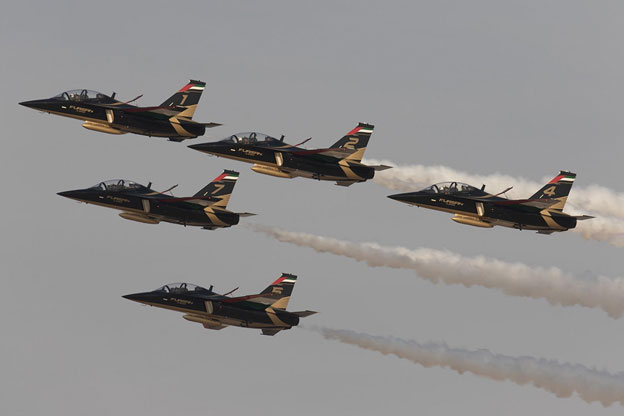
From breathtaking jet manoeuvres in the sky to static displays of giant planes on the tarmac, it was a show of power and prestige. There was also a company like Joby Aviation which has built flying taxis and will debut the service in Dubai next year.
The 2025 event is where Boeing finally got the lifeline it desperately needed after a prolonged safety crisis.
The Boeing 737 Max plane had two deadly crashes—five months apart—killing hundreds of passengers on Ethiopian Airlines Flight 302 in March 2019 and Lion Air Flight 610 in October 2018. The plane was grounded for 21 months but has now regained the confidence of airlines going by the massive order book.
In the end, Airbus and Boeing were the clear winners, not to mention Emirates and flydubai who were on their home turf. China’s COMAC also showcased its flagship aircraft the C919 and the C909.
Etihad Airways grew its widebody fleet by ordering 32 Airbus aircraft: a mix of A350s, A350F freighters and A330neos. Earlier this year, Etihad ordered 28 additional Boeing widebody aircraft, bringing the airline’s total new widebody orders for 2025 to 60 across Airbus and Boeing.
However, the Abu Dhabi-owned airline has struggled to scale the heights of its Gulf counterparts, Emirates and Qatar Airways. Analysts say Etihad was essentially trying to run a mega-hub model without the passenger base, geography, or brand power of the two carriers. The result, they say, was a painful reset: massive restructuring, fleet downsizing, route cuts, and a strategic pivot from “global titan” to “boutique premium carrier”.
The glitz and glamour demonstrated the resilience of the industry and a remarkable turnaround five years after Covid-19 grounded every plane. Every order made was a bet on the future of global travel.
The Dubai Air Show serves as a dramatic stage where the economic and geopolitical power of the Gulf nations is flexed.
These countries flex their financial muscle not just through massive, multi-billion-dollar commercial orders from giants like Emirates, Etihad and Qatar Airways—which drive the global aviation industry—but also through strategic defense procurement.
Ultimately, the scale of the deals signed reinforces the Gulf’s rising stature as an essential global hub for transport, finance, and defence, projecting their influence well beyond the Middle East.
The show also provides an opportunity for the UAE to showcase its space ventures. The Mohammed Bin Rashad Space Centre showed off its rovers and lunar stations and gave updates on its space missions.
The vision of Tim Clark
Traditionally, the show has also been an opportunity for airline executives to jostle for influence in the industry. Tim Clark, long-time president of Emirates, has consistently been a prominent and active participant at the Dubai Airshow.
His high-profile attendance is a regular fixture at the most anticipated event of the aviation industry. Clark is a highly respected figure in the industry and is known to use the platform to speak about Emirates’s strategic direction as well as express his frustration with manufacturers like Airbus and Boeing.
Known as the godfather of network planning in aviation, Clark fundamentally reshaped the way airlines view global connectivity, hub-and-spoke systems, and long-haul travel. His focus on turning Dubai into a global hub that connects passengers to virtually every corner of the world not only helped Emirates become a leader in air travel but also influenced the broader airline industry’s strategies.
Clark was there at the founding of Emirates in 1985 and has been president since 2003. It was in the backdrop of the airline’s success that the Dubai Air Show became a signature aviation event.
Military might
The show is a key meeting point for high-level military delegations from around the world, turning it into an arena where major powers like the US, Russia, and China vie to sell advanced fighter jets, missiles, and defense technology to wealthy, security-conscious Gulf monarchies.
The F35 fighter jet manufactured by US defence giant Lockheed Martin went head-to-head with Russian United Corporation’s Su-57 in a show of military might.
Not to be outdone, a Chinese delegation showcased fighter jets J-35A and J-10CE. The China National Aero-Technology Import and Export Corporation (CATIC) booth also had the Y-20 transport aircraft, L-15A training aircraft and Wing Loong drones to potential customers.
The UAE Air Force and the Indian Air Force put up stunning aerial performances. A host of defence corporations like RTX, Hindustan Aeronautics Limited, Roketsan, and EDGE showcased their capabilities and hardware.
The fighter jet displays coincided with developments miles away, where a meeting at the White House between US President Donald Trump and Saudi Crown Prince Mohammed bin Salman resulted in an agreement where the US would sell F35 fighter jets to Saudi Arabia in a multi-billion dollar deal. If the deal goes through, Saudi Arabia would be the second country in the Middle East in possession of the stealth jets after Israel.