The Independent Uganda: You get the Truth we Pay the Price



Luanda Summit signals a historic shift toward continental self-reliance in development funding
NEWS ANALYSIS | RONALD MUSOKE | In Luanda, the Angolan capital, where the Atlantic Ocean breeze carries both the promise of prosperity and the weight of unmet potential, African leaders gathered there recently for a defining conversation about the continent’s future.
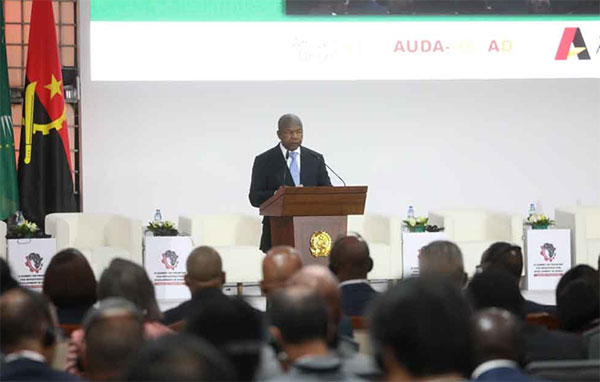
The third summit on financing for infrastructure development in Africa, held under the patronage of Angolan President João Manuel Gonçalves Lourenço and the African Union Commission, was not another talk shop. It was a declaration of intent: to build the Africa that Africans have long envisioned, with African resources and resolve at its core.
For four days (October 28-31) Luanda became the epicentre of Africa’s infrastructure revolution. Presidents, ministers, financiers, and development partners met under the banner “Capital, Corridors, Trade: Investing in Infrastructure for the AfCFTA and Shared Prosperity.” The focus was as ambitious as it was urgent: turning political will into bankable projects and closing the continent’s infrastructure financing gap — a staggering US$130 to US$170 billion a year, according to the African Development Bank.
A new phase of self-determination
In his opening address, President Lourenço captured both the gravity and the hope that defined the Summit. “We must move from words to action,” he said. “This Summit represents a decisive step toward mobilizing the resources needed to enhance connectivity and integration across our continent.”
He reminded delegates that Africa’s infrastructure deficit was not just an economic shortfall but a social and political one — a brake on the continent’s growth and unity. “We are gathered not only to discuss numbers or projects,” he said, “but above all to reaffirm our common vision of a connected, modern, and resilient Africa.” The tone resonated and across the conference halls of Marginal de Luanda, one message echoed, that Africa is ready to finance its own destiny.
African Union Commission Chairperson Mahmoud Ali Youssouf framed the summit as a turning point in Africa’s development philosophy. “We are shifting from a logic of assistance to a logic of alliance,” he said. “Partners must align their engagement with priorities defined by Africa itself,” he said.
His words carried the weight of a continental pivot — a move from dependency toward determination. Infrastructure, he stressed, was not merely technical; it was political and strategic. “What we are building here are not merely roads and bridges,” Youssouf continued. “We are building an Africa that is connected, confident, and sovereign.”
The sentiment encapsulated the evolution from the era of donor dependency to one of ownership and agency. The Summit, co-hosted by the African Union Commission (AUC) and the African Union Development Agency (AUDA-NEPAD), represented this shift in action.
For AUDA-NEPAD CEO, Nardos Bekele-Thomas, the Luanda Summit marked the maturation of a process that began in the Senegalese capital, Dakar, two years ago. “The lesson from Dakar is clear,” she said. “We can no longer treat financing as a fragmented market of scattered deals. We must transform it into a unified strategy.”
That strategy is already yielding results. Bekele-Thomas said the African financial institutions had mobilized US$1.5 billion for cross-border projects since the Dakar summit, including a first close of US$118 million under the Alliance for Green Infrastructure in Africa’s Project Development Fund, managed by Africa50, a pan-African infrastructure investment platform and asset manager established to to help brdige the infrastructure funding gap. The Luanda gathering, she said, was about deepening that momentum — aligning financial innovation with Africa’s political will.
And, unlike many continental summits, Luanda was heavy on deals and light on rhetoric. In a flurry of signings, AUDA-NEPAD concluded three landmark memoranda of understanding designed to demonstrate Africa’s capacity to finance its own development.
First, the African Union development agency and the Alliance of African Multilateral Financial Institutions (AAMFI) agreed to mobilize up to US$1.5 billion, including US$100 million for project preparation. The initiative will test joint resource-mobilization mechanisms and serve as a bridge to the establishment of the African Union Development Fund.
A second memorandum of understanding is with the African Social Security Association (ASSA) aiming to tap the continent’s vast pension funds to create an Infrastructure Development Fund for Africa (IDFA). “Africa’s social security and pension systems hold immense potential for development finance,” Bekele-Thomas said. “It’s time those resources worked for Africans.”
The third agreement with CATA Energy, established the Africa Green Transition PPP Fund, a blended finance vehicle to accelerate renewable energy investments in mining corridors and industrial zones. Each of these partnerships, Bekele-Thomas noted, was a “proof of concept for African financial sovereignty.”
Deal rooms and digital corridors
Beyond the plenaries and speeches, Luanda’s “Project Boardrooms” pulsed with quiet intensity. In these dedicated “deal rooms,” 13 advanced projects across transport, energy, water, and ICT were pitched directly to investors. From the Grand Inga Hydropower Project to transcontinental ICT cables, the goal was clear: move from concept to capital.
The InfraTech & Innovation Forum showcased startups offering AI-powered monitoring systems and e-mobility solutions — proof that Africa’s digital transformation is accelerating alongside its physical one. The Summit also advanced conversations on the African Single Electricity Market (AfSEM), green power interconnections, and water-security initiatives, all key to the continent’s sustainability agenda.
Infrastructure is often spoken of in numbers and blueprints, but its human dimension is what truly drives the story. For the African Continental Free Trade Area (AfCFTA) — a market of 1.4 billion people — roads, ports, and digital corridors are the arteries of integration.
Without them, the AfCFTA remains a promise on paper. Commissioner Mataboge captured the link succinctly saying: “We cannot talk about the Africa we want without first building the infrastructure we need.” Indeed, every kilometre of railway built, every power line connected, and every airport modernized brings Africa closer to its dream of shared prosperity.
A US$30 billion aviation plan
But, perhaps one of the summit’s most ambitious announcements came from Lerato Dorothy Mataboge, the African Union’s Commissioner for Infrastructure and Energy. She unveiled a US$30 billion investment plan to modernize the continent’s aviation infrastructure under the Single African Air Transport Market (SAATM). She said aviation is “a strategic engine of continental integration.”
“Aviation is not merely a mode of transport,” she said. “It is a strategic enabler of Agenda 2063 and the AfCFTA.” According to a continental study conducted by AFCAC- the African Union’s specialized agency for civil aviation, the International Civil Aviation Organization (ICAO), and the World Bank, Africa will need up to US$30 billion over the next decade to close critical aviation infrastructure gaps, as passenger traffic is projected to triple from 160 million in 2024 to nearly 500 million by 2050.
The AU’s plan aims to mobilize US$10 billion in public finance to attract another US$20 billion from private and institutional investors. The modernization drive also includes green airports, equipped with renewable energy systems, to align with global sustainability goals.
“As we modernize African skies, we are doing so sustainably,” Mataboge emphasized. “Every project is designed to reduce fuel consumption and carbondioxide emissions and to attract the world’s growing pool of climate-focused capital.”
Angola’s example: Building the future at home
While the Summit spoke to continental ambition, the host nation offered a living example of what determined investment can achieve. Angola, preparing to celebrate 50 years of independence this year on November 11, has embarked on a massive infrastructure modernization programme; from roads and ports to power and telecommunications.
President Lourenço detailed his country’s plans: the expansion of the António Agostinho Neto International Airport, the construction of new dams like Caculo Cabaça, capable of producing 2,172 megawatts, and the development of the Lobito Corridor, a strategic railway linking Angola to the Democratic Republic of Congo and Zambia.
“Every kilometre of road, every megawatt of energy, and every fibre-optic network must contribute directly to the well-being of Africans,” he said. For Lourenço, infrastructure is not just about physical assets — it’s about transforming opportunity into prosperity. “Infrastructure development is a means to create jobs, promote intra-African trade, foster integration, and improve living conditions,” he said.
The politics of possibility
But the Summit did not shy away from reality. Delegates acknowledged the persistent challenges — from limited fiscal space and currency volatility to investor risk perceptions shaped by global credit-rating agencies. President Lourenço challenged these narratives head-on.
“We must address the ways in which rating agencies misrepresent the realities of our economies,” Mataboge said. “Their analyses do not always reflect Africa’s record of fulfilling obligations.” His call echoed a growing African consensus: that the continent’s financial reputation must be rewritten by its own performance, not its past.
By the time the final sessions concluded, optimism had replaced fatigue. The Luanda Declaration, set to be presented to African Union bodies, will consolidate commitments made during the summit — from financing frameworks to infrastructure partnerships.
It will, in Lourenço’s words, “harmonize actions in each of our countries to ensure the effective mobilization of resources.”
As the sun set over Luanda’s skyline, casting its glow over the city’s new highways and gleaming port cranes, the symbolism was impossible to miss. Africa, once defined by its infrastructure deficit, is now defining itself by its determination to overcome it. From Dakar to Luanda, the journey is clear — from dependency to determination, from pledges to projects, from plans to prosperity.
“Our ambition is great,” President Lourenço said in his closing remarks. “Our goal is to build the infrastructure that will support technological development, electrification, and industrialization — to guarantee the future of our youth and generations to come.”