The Independent Uganda: You get the Truth we Pay the Price


Can he be first to run marathon under 2hrs?
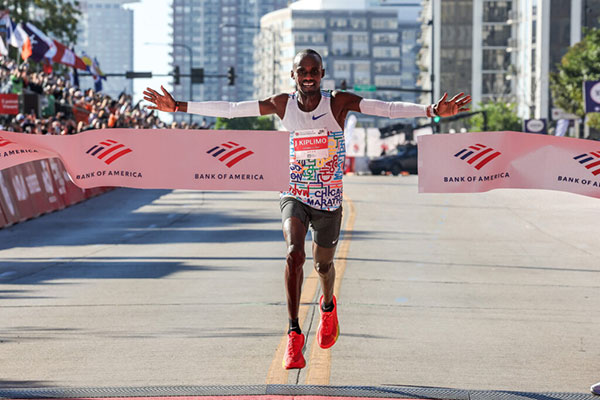
COVER STORY | BY AGENCIES | Uganda’s Jacob Kiplimo, in just his second ever competitive run over 42.195KM, dominated to win the men’s 2025 Bank of America Chicago Marathon in 2:02:23.
That win has reawakened a question that Sean Ingle, the Guardian’s chief sports reporter, posed in an article in April soon after Kiplimo ran a half marathon time 48 seconds quicker than anyone else in history. That was in Barcelona, Spain, where Kiplimo covered the 21.1km in 56min 42sec.
Sean Ingle asked: “Will Jacob Kiplimo be the first to run a marathon in less than two hours?”
Sean Ingle described Kiplimo’s performance in Barcelona as “so staggering that it sent the jaws of even seasoned track and field watchers crashing to the floor”.
Sean Ingle was writing as Kiplimo was making his full marathon debut in London on April 27.
“Do I think he could one day be the athlete that runs under two hours? Yes,” said Sean Ingle. He wrote that Hugh Brasher, the London Marathon race director, also thought so.
But when Sean Ingle asked Kiplimo whether he could one day break two hours for the marathon, he was cautious.
“Yes, of course,” he reportedly told Sean Ingle, “Maybe in the future.”
In London Kiplimo competed against the world’s marathon elite, including Eliud Kipchoge, the greatest of all time, the Olympic champion Tamirat Tola, and the 2024 winner Alexander Mutiso. Kiplimo finished second in the London Marathon behind Sebastian Sawe with a time of 2:03:37, a Ugandan national record.
The win in Chicago was not just the first marathon victory of Jacob Kiplimo‘s career, reports Letsrun.com; it was the first ever by a runner from Uganda (If one counts only the seven World Marathon Majors races and not the Olympics/Worlds).
Uganda now joins the list of 14 countries that have now won marathon majors since the series began in 2006 (Tokyo joined in 2013 and Sydney in 2025).
There have been 107 majors held since the start of 2006, which means 214 total champions (men’s and women’s). Kenya (120 wins) and Ethiopia (67) have dominated to a comical degree, combining to win 187 of the 214 titles (78%).
Perhaps surprisingly, the U.S. ranks third with six wins (Deena Kastor, Meb Keflezighi x2, Galen Rupp, Shalane Flanagan, Des Linden).
For perspective, if Eliud Kipchoge (13 wins) and Mary Keitany (7 wins) were their own countries, they would rank third and fourth on this list ahead of the U.S.
No one has run a marathon in under 2 hr. The current men’s marathon world record is 2:00:35, set by Kelvin Kiptum (Kenya) at the Chicago Marathon on October 8, 2023. The women’s marathon world record is 2:09:56, set by Ruth Chepngetich (Kenya) on October 13, 2024.
In 2019, Kenya’s Eliud Kipchoge became the first person in history to run a marathon in under 2 hr, clocking a time of 1 hr 59 min 40 sec at the INEOS 1:59 Challenge in Vienna, Austria.
But his record is not considered an official world record because special technical arrangements were made to optimise the conditions for his run. These included having 41 rotating elite runners as pacemakers to shield him from the wind, a special flat course, ideal low temperature weather, runners on bicycles providing him with drinks and energy gels every 5 kilometers, and a prototype of Nike’s Vaporfly shoes, which included carbon-fiber plates in the sole to provide a better forward push and improve energy efficiency. These technical arrangements meant that this couldn’t qualify as the official marathon record. But he broke a barrier that for years had been considered impossible.
“It is a great feeling to make history in sport after Sir Roger Bannister (set the first sub-four-minute mile) in 1954. I am the happiest man in the world to be the first human to run under two hours and I can tell people that no human is limited. I expect more people all over the world to run under two hours after today,” Kipchoge said after his race.
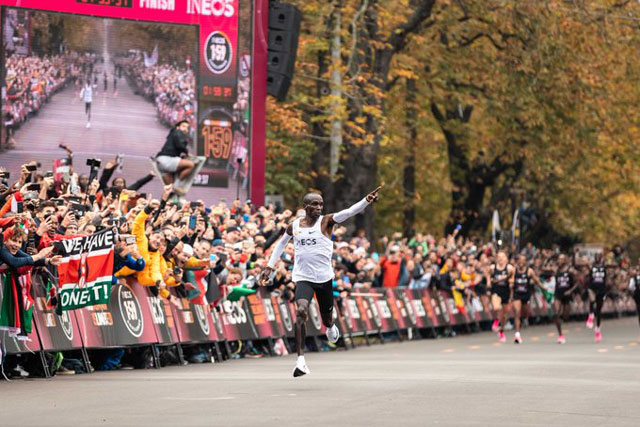
Kipchoge ran a consistent pace set by the electric timing car and the pacemakers of 2:50min/KM throughout the race with every single KM split being between 2:48min/KM – 2:52min/KM. At the time, Kipchoge was 36 years old. In comparison, Kiplimo ran every single KM split in an average 2:54 min/KM. Kiplimo is just 24 years old.
Letsrun.com reports that Kiplimo showed no fear and gave the 2:00:35 world record a scare before settling for the win in 2:02:23, the second-fastest time ever run in Chicago. The mark puts him seventh on the marathon all-time list. Kiplimo also took home $100,000 (Approx. Shs346 million) for the win.
Amos Kipruto, 33, of Kenya, was second in 2:03:54, and Alex Masai, 27, also of Kenya, was third in 2:04:37. Conner Mantz, 28 of the U.S., placed fourth in 2:04:43, accomplishing his goal of breaking Khalid Khannouchi’s long-standing American record of 2:05:38 in the process. Defending champion John Korir dropped out of the race after the 20-mile mark.
Letsrun.com reports, however, that the opening splits in the Chicago Marathon were wild. With perfect conditions (54 degrees, sunny, tailwind of 9 mph wind out of the SE at start), Kiplimo and the leading pack of four set out at a fast clip, covering the first 10KM in 28:25, a 4:34 pace. That would have put the lead pack of five—including Korir, Kiplimo, and Kipruto—under a two-hour finish.
They went through the half-way mark in a blistering 60:16 although their four pacers had been instructed to go through the halfway mark at 60:30. To put that into perspective, the projected time at 21KM was 2:00:31, four seconds under Kelvin Kiptum’s world record of 2:00:35 from Chicago two years ago.
Even though the splits were super fast, Kiplimo looked totally relaxed, which makes sense as he’s run 56:42 in the half-marathon — 48 seconds faster than anyone else.
Around 18 miles, LetsRun.com co-founder Robert Johnson’s 7-year-old son walked into his office and saw Kiplimo all alone and asked him, “Is that guy going slow?” No, he wasn’t, but we understand why a child would ask that as Kiplimo just looks so relaxed.
But the pack slowed slightly when they turned back south into the headwind. At the halfway mark, the pacers dropped out and Korir pushed to the front. Kiplimo soon joined him.
By the 25km mark the duo had established a 10-second gap to the rest of the field and went through in 71:12, with the projected time forecast down to 2:00:10. The pre-race narrative of a head-to-head between Kiplimo and Korir started to unfold. But then Kiplimo made a decisive move. He ran the next 5KM in 14:19, a 4:36 pace, pulling 12 seconds ahead of Korir, who covered the same distance in 14:31 (4:40 pace).
It was at that point that Kiplimo surged to put distance between himself and Korir. He was keen to go one better in Chicago. By 30km (1:25:31; 2:00:16 pace), Kiplimo was all alone.
Still under world record pace, he went through 35km in 1:39:53. With Korir dropping out around the 34km mark, Kiplimo was now over a minute ahead to the rest of the field and, now alone, started to slow down.
It was at the 37KM that Kiplimo fell behind world record pace – his projected time at this stage was 2:00:47 – and from then on in it was just about securing the victory and bettering his time of 2:03:37 from London. His final 5 mile splits were 4:46, 4:50, 4:55, 5:05 and 5:20 (WR pace is 4:35.95 per mile), but he still held on for his first marathon win.
He peeked over his shoulder a few times during the last mile of the race but had nothing to worry about as he jogged through the final straight all by himself.
After crossing the finish line, Kiplimo appeared to be in pain. He collapsed to the ground and had to be helped to his feet by race director Carey Pinkowski. He sat down in sheer exhaustion and was visibly hurting—his legs were “a little bit tired,” he said.
Lessons learned
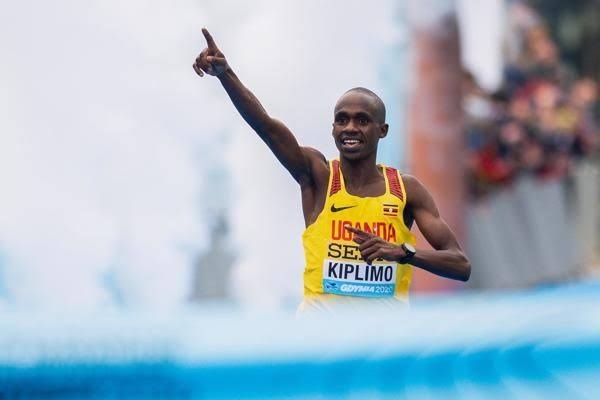
“I’m so happy to take the win in Chicago and this is a big achievement for me today,” Kiplimo said. “I knew that the guys were pushing a little too fast so it was tough to maintain that pace. I just wanted to run my personal best today and maybe run around 2:02. This is only my second marathon and I know I will improve on this one.”
He noted that he took away lessons he could apply to the third.
“I’ve learned a lot that in the marathon, you need to be patient. It’s about how you prepare yourself, how you add the mileage in your body.”
Kiplimo was regarded as a superstar in waiting even before he competed over 5,000m as a 15-year-old prodigy at the 2016 Rio Olympics. He had a humble upbringing on a farm in Kween, 1,500m above sea level on the Mount Elgon volcano. But, because his father had three wives, he had many older half-brothers to run with – including Robert Chemonges and Victor Kiplangat, both of whom have gone on to be sub 2hr 10min marathoners – and soon proved to be something special.
“We were helping our brothers, the big brothers,” he says. “They were running and we kept seeing them when they were training. And one day, I tell them: ‘I want to become like you.’ So I just kept training, training. This was when I was around 10 or 11.”
A few years later Kiplimo was spotted and brought to Italy to train for the 2016 Olympics.
“Afterwards my coach, Giuseppe Giambrone, said to me: ‘You will be one of the greatest runners in the world,’” says Kiplimo. “It ended in the semi-finals. But it was a huge experience for me to be at the Olympics.”
Kiplimo’s staggering performances as a 15-year-old included running the 5,000m in 13min 19.54sec and the 10,000m in 27:26.28 – all in the era before supershoes.
But despite going on to win two senior world cross country titles as well as Olympic and world 10,000m bronze medals, his lack of a devastating sprint finish ended up hurting him on the track. On the roads it has so far been a different story. Kiplimo says he feels much stronger having gone from running around 120-145km a week during his track career to over 200km a week for the marathon.
In post-race comments Kiplimo said: “Coming here and winning means a lot to me. I proud of this result but I believe I can go even faster”. He emphasised that for him, winning is about how you prepare yourself and not about breaking records.
Uganda’s Minister of Education and Sports, Janet Kataaha Museveni, congratulated Kiplimo on his victory with a post on X.
“Congratulations, Jacob, for proudly carrying our flag in Chicago! Your victory brings joy to Uganda and serves as a testament to what faith and hard work can achieve,” she wrote.
Peter Ogwang, Uganda’s State Minister for Sports, also commended Kiplimo.
“Once again Kiplimo has done it for Uganda. We celebrate him for flying our national flag high.”
The Katikkiro of Buganda, Charles Peter Mayiga, also congratulated him.
“I congratulate Jacob Kiplimo upon winning the Chicago Marathon! Something for Uganda to be proud of, on the international stage,” he said.
One for the books
The Chicago Marathon was one for the books for Kiplimo, his fan base and the Chicagoan spectators. The weather could not have been any better. As one writer described it; “Ribbons of sunlight glittered against clear blue skies while a refreshing breeze rolled off the Lake Michigan—the platonic ideal of a crisp fall day in the Midwest.” The runners brought electric energy to the race, while spectators brought good will and, of course, hilarious signs.
Up to 53,000 runners hit the pavement for this year’s Chicago Marathon. Of the participating runners, 25% were visiting Chicago for the first time, and a third came in from international locations, according to Bank of America Chicago president Rita Cook.
The race also pours $680 million into the city’s economy, as the runners and those who travel with them are staying at Chicago’s hotels, eating at the city’s restaurants, and shopping at local businesses.
Cook also emphasised the philanthropic benefits the marathon generates.
“I think the bigger piece is the 18,000 runners that are giving back to over 200 causes,” she said. “That is really important from a philanthropic perspective.”