The Independent Uganda: You get the Truth we Pay the Price


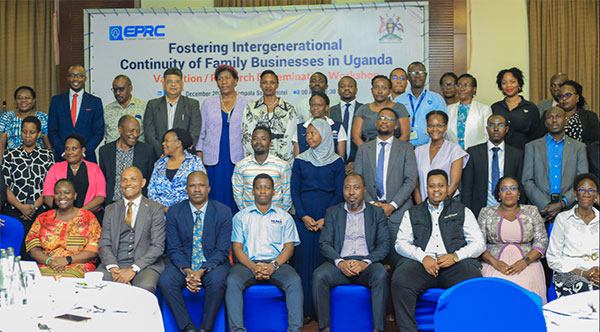
A new EPRC study exposes structural cracks threatening the future of Uganda’s most influential enterprises.
Kampala, Uganda | JULIUS BUSINGE | Uganda’s most common business structure—the family enterprise—is facing a quiet but severe generational crisis. Fewer than 10% of family-owned businesses in the country survive beyond their founders; a trend researchers warn threatens not only individual wealth creation but the entire private-sector growth pipeline.
The reality, presented on Dec.9 at a high-level dialogue hosted by the Economic Policy Research Centre (EPRC) in Kampala, has stirred fresh debate among business owners, policymakers and academics about the future of family-led enterprises.
The discussion was anchored by a newly released EPRC factsheet, From Generation to Generation: Key Facts on Family Business Survival in Uganda, authored by researchers Linda Nakato, Pauline Nakitende, Medard Kakuru, Rogers Matama and Smartson Ainomugisha.
The publication paints a stark picture: while family firms account for more than 70% of Uganda’s GDP and form the bulk of micro, small and medium enterprises, their longevity remains dangerously low. The ratio of first-generation to multi-generational family businesses stands at 4:1, meaning that for every thriving second- or third-generation business, four others stall at the founder stage.
EPRC Executive Director Sarah Ssewanyana, in remarks delivered by Director of Research Ibrahim Kasirye, described the fragility of these enterprises as both an economic and developmental risk.
She said many family firms crumble under shocks such as market volatility or the sudden loss of a founder because they lack robust governance structures, financial discipline or a clear succession roadmap.
“Without proper succession plans, governance systems or financial procedures, most family-owned businesses collapse at the first kind of crisis,” she said, stressing that the implications extend beyond boardrooms into national prosperity.
Why family businesses fail
Presenting the study findings, Research Fellow Linda Nakato explained that most family enterprises in Uganda are still young and structurally weak, with founders managing decision-making tightly and formal governance mechanisms rarely in place.
The predominance of first-generation firms suggests that founders often fail to institutionalise systems that would support smooth transitions to spouses or children. The consequences are predictable: once the founder steps aside—voluntarily or otherwise—the enterprise frequently loses direction.
Business leaders at the meeting shared candid stories about the delicate balance between family and business.
Kampala Quality Schools founder, Jennipher Kasisiri, described integrating her children into the enterprise as a gradual, deliberate process that began years before they were old enough to work.
“It is not an overnight event,” she said, emphasising the importance of early exposure and structured involvement.
For Rugyeyo Coffee Farm proprietor, Robert Kabushenga, the heart of the problem lies in unmanaged family dynamics. “The key fundamental question of governance is not at the board of the business. It is at the family level,” he said.
Kabushenga urged families to establish family offices—structures that define roles, expectations and conflict-management processes—to prevent personal disagreements from spilling into business operations. He added that children should not be coerced into joining enterprises and cautioned against assuming that a spouse automatically qualifies as a business partner.
Indian Business Association Chairman Rajesh Kumar attributed long-lasting family businesses within the Indian community to frugality and disciplined reinvestment.
Warning that extravagant lifestyles erode business capital, he cited the downfall of Kingfisher India as a cautionary tale.
“Instead of spending on luxury life, if you can put that money back into the business, you will earn much more,” he said.
Numa Foods’ Sales and Marketing Lead, Isaac Asiimwe, underscored the importance of spousal partnership in business resilience.
He recounted how a fire that destroyed their factory was only overcome because savings from his mother’s separate secretarial bureau were reinvested to rebuild.
He argued that such sacrifices are only possible where there is mutual understanding and trust at home.
A sector too critical to ignore
Beyond personal experiences, the authors of the factsheet argue that the survival of family-owned firms has broad economic implications.
Family enterprises dominate Uganda’s private sector, providing employment, stimulating local investment and fostering innovation. Their collapse, therefore, creates ripple effects—shrinking job opportunities, disrupting supply chains and weakening community-level economic activity.
The study identifies three critical weaknesses undermining continuity: weak governance systems, a lack of formal succession plans and minimal professionalisation.
Most founders maintain tight control, often sidelining non-family professionals whose skills could build strong operational foundations. The absence of structures like formal boards, succession documents or role delineations leaves companies adrift when leadership transitions occur.
Policy recommendations emerging from the research include targeted support for capacity building in governance, financial management and succession planning.
The factsheet calls for deliberate efforts to encourage founders to professionalise early—introducing clear governance systems, hiring competent managers and preparing family members through mentorship rather than entitlement.
Presidential CEO Forum Chairperson Irene Birungi Mugisha described the EPRC initiative as the start of an “important national conversation,” calling for coordinated public-private efforts to protect the future of family enterprises.
She said strengthening succession systems is essential for safeguarding Uganda’s entrepreneurial pipeline and building generational wealth.
The factsheet’s release comes at a time when family businesses across East Africa face increasing pressure from technological change, shifting consumer behaviour and rising competition. Without deliberate action, researchers warn, Uganda risks losing a vital engine of economic growth.