 The Independent Uganda: You get the Truth we Pay the Price


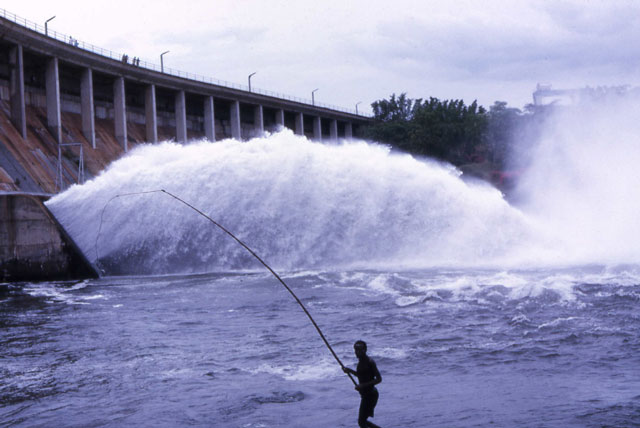
COMMENT | NADA ANDERSEN | The water levels of Lake Victoria – that the locals call Lake Nalubale – have risen dramatically in recent years, displacing communities, destroying livelihoods, and causing ecological damage – yet public awareness and policy responses remain weak.
Despite an article in the New Vision on 3rd January 2025, arguing that people living in the riparian belt are the ones causing the ecological catastrophe, a look at the available facts and information indicates something much bigger is destroying the lake.
Information about Nalubale is admittedly scarce. Scouting the government websites and publications over the past few years, we have been unable to find reliable statistics on water levels and water releases at Nalubale Dam in Jinja. To understand why consistent release is essential, we need to go back in history to the agreement between the United Kingdom and Egypt to build the dam to provide electricity for industries in Uganda and to retain the water in Nalubale as a safety net for Egyptian agriculture. In the end, Queen Elizabeth travelled to Uganda in 1954 to cut the ribbon, and Egypt placed a permanent military presence at Jinja and Kololo.
The dam submerged Jinja (Rippon) Falls to create an accumulation of water, but it was not producing electricity at the expected capacity. It was then decided they remove a portion of Jinja Falls to increase water pressure and raise the water level by 1-2 metres. Displaced people were supposedly compensated, but no clear record of the compensation is available online.
Flooding by one metre vertically in a shallow lake like ours means flooding by 10-30 metres horizontally, so settlements that flood today were at a fair distance from the water before dam construction. A rough estimate is that Nalubale today sits up to three metres higher than its natural state when Jinja Falls regulated the lake level.
Water release from the dam was controlled by a simple mathematical calculation that produced a graph known as “The Agreed Curve”.
The more water in the lake, the more is being released out of Nalubale Dam. Around 2005, we released too much water, causing the lake to recede significantly. Since then, the lake has been steadily rising, causing consistent flooding.
We know, but choose to ignore, the fact that the first ecological catastrophe occurred in the last century, when the lake was artificially raised above its natural level, flooding vast areas along its shores and causing silting and erosion.
Since then, we have done nothing to correct this, and in the same breath, we are not releasing sufficient water from Nalubale Dam to keep the lake level under control. The impact is that there are over 50,000 displaced people in Kisumu alone, who have sued the Ugandan Government at the East African Court of Justice.
Statistics on the displacement of fishing villages and homesteads in riparian areas in Uganda over the past five years are not readily available.
⚠🦠🧟♂️🧌☠☠☠☠ pic.twitter.com/E8z6wX4hb8
— Nada Andersen (@NadaAndersen) January 3, 2026
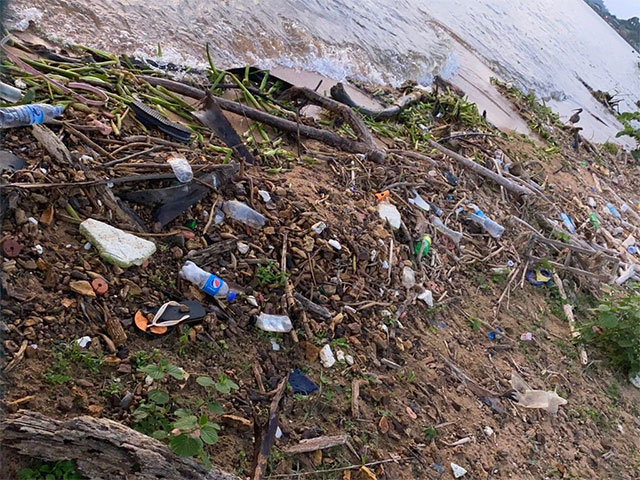
The agenda-setting is to blame the little guy: a fisherman eking out a living from the lake, or his wife doing the laundry in the lake water. They need to move and vacate the 200-metre belt around the lake, while polluting industries remain unchecked right by the lake shores. Swamps are already covered by solid houses, killing the little hope for natural filtration, and trash dump sites like Nkumba operate freely, some 50 metres away from the swamp, constantly oozing toxic sludge and plastic particles into the lake.
Framing the narrative to blame the ordinary people is factually and morally wrong. Our institutions did nothing to reverse the impact of the first ecological catastrophe imposed on Nalubale in the fifties of the last century.
There is no focused garbage management to date, even after the Kitezi disaster. The Kaveera ban that never happened, the absence of sensitisation about garbage sorting and disposal, the unchecked industry releases of pollutants into the lake, the return of water hyacinth, uncontrolled sand mining, and the continuing raising of the water level are all contributing to the disaster we are facing now. We are all guilty, but to single out only one segment of the population, the one that cannot defend themselves or stand their ground, is evil.
It is important to note that Nalubale Dam is also now exceeding its projected lifespan. When built and commissioned, it was to last a maximum of seventy years. Various cracks on the dam have been repaired in the past.
The pressure of water exerted on the dam is not constant – it rises together with the water level. For anyone unable to imagine what will happen if Nalubale Dam gives way, let me paint you a picture: the mass of water gushing from the lake can wipe out everything downstream: people, homes, hotels, lodges, fields, dams – everything. I often pray to Nalubale to be kind. However, only action can spare us from a disaster.
The first and most radical action is to decommission Nalubale Dam and relieve the pressure on the dam structure. With this, the Kiira turbines will stop working, but this is the price we have to pay to keep the people and the Karuma and Isimba Dams safe. A consistent increase in water release, with adequate flood warnings, should occur over the next several years to bring the Nalubale back to its natural level, regulated by natural rainfall and lake tributaries.
Further action would consist of a lake cleanup, and not only along the lake shores. Closing of garbage dumps near the lake, securing the existing garbage dumps to prevent seeping of toxins, education of citizens on garbage disposal, implementation of the ban on plastic packaging, ban on fishing within the fish breeding zones, construction of decent low-cost settlements with appropriate sanitation facilities to replace current fishing villages – these are just some small interventions we can make to preserve the Nalubale ecosystem and reverse the damage so far done. The future of Nalubale belongs to all of us. This lake has been too kind, and we finally need to show it some respect.
*****



The article comes across as a “katogo” of ideas, which unfortunately dilutes several otherwise strong arguments. It is not clear which issue the author seeks to foreground; whether it is the rising water levels, the rubbish dump, concerns about the ageing Nalubaale Dam, or the government’s emphasis on pursuing illegal fishermen and their wives rather than addressing the water levels.
Andrew is an excellent writer and spinner, why didn’t he edit this article to give it a clearer focus and a much more consistent flow of ideas?