The Independent Uganda: You get the Truth we Pay the Price


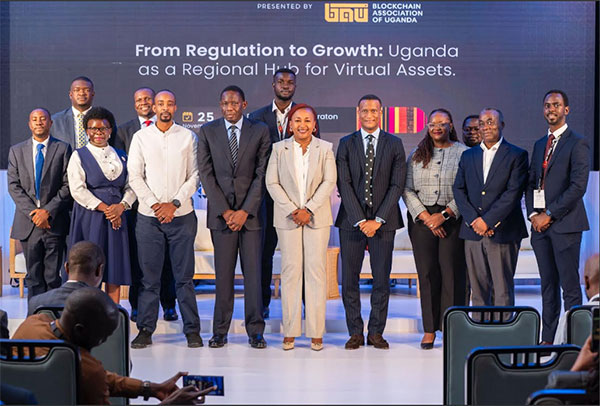
Kampala, Uganda | PATRICIA AKANKWATSA | Uganda’s ambition to position itself as a regional hub for virtual assets took center stage at the Blockchain summit as top regulators, industry leaders and innovators convened at the summit held at the Four Points Hotel in Kampala. The day-long meeting delivered the clearest signal yet that the country is preparing to shift from cautious observation to deliberate regulatory action amid mounting regional competition led by Kenya.
Bank of Uganda Governor Dr Michael Atingi-Ego set the tone with a keynote that blended urgency and a challenge to both policymakers and the private sector.
“This is not a mere third annual summit. It is a third step in the journey that will determine whether Uganda leads or follows in the digital transformation of finance,” he said.
“The question for Uganda is no longer whether these technologies matter. It is whether we will be architects of their adoption or mere users of systems designed elsewhere.”
Dr. Atingi-Ego rejected the notion that Uganda’s slow pace in embracing virtual asset regulations reflects reluctance.
“Our stance has not been hesitation. It has been prudence,” he said, defending the central bank’s long-held warning that virtual assets are not legal tender.
He argued that years of consultations with regulators, the Blockchain Association of Uganda, and global standard-setters were aimed at building understanding before crafting enforceable rules. The governor likened this to Uganda’s long, methodical approach to oil sector governance.
“Patience is prudence. Stakeholder consultation is very key,” he noted.
Early findings from Uganda’s national risk assessment highlight the stakes. According to the Financial Intelligence Authority, 84.5% of virtual asset activity in Uganda occurs on decentralized platforms far above the Sub-Saharan Africa average of 63.8%.
“This means most Ugandan users operate in environments where supervision is technically challenging and consumer recourse is practically non-existent,” Dr. Atingi-Ego warned.
Stablecoins, used widely for remittances and cross-border payments, pose further risks including monetary substitution as Ugandans hold value in foreign currency-pegged digital tokens rather than the shilling.
“Regulatory uncertainty is no longer tenable. But outright prohibition is neither desirable nor effective.” he emphasized.
Much of the governor’s speech underscored a sobering reality: Kenya has overtaken Uganda in establishing a functional virtual asset framework.
On November 4, Kenya began implementing its Virtual Asset Service Providers Act introducing nine categories of licensed activities and clear division of oversight between the central bank and capital markets authority.
“Kenya provides clarity. We are still developing ours. What will Uganda’s competitive advantage be? Why would a firm choose Kampala over Nairobi?” Dr. Atingi-Ego said.
He argued Uganda can still lead by delivering high-quality, stakeholder-driven legislation and by building world-class supervisory capacity.
The governor outlined the architecture he expects to guide Uganda’s regulatory approach; Licensing and fit-and-proper standards, Client asset protectional/CFT compliance, including the FATF travel rule, Cybersecurity and operational resilience, Market integrity and conduct standards and Transparency and data reporting
“These pillars are not theoretical. They are the backbone of every jurisdiction that has integrated virtual assets safely,” he noted.
Reginald Tumusiime, Chair of the Blockchain Association of Uganda, described the summit as the culmination of a six-year journey.
“This moment represents six years of patience and deep commitment,” he said. “We engaged regulators not as adversaries but as partners seeking to build something unprecedented.”
Tumusiime credited the governor for accelerating the regulatory process, recalling a pivotal 2022 dinner with the then–Deputy Governor.
“From that moment, he pursued this vision relentlessly,” he said.
Tumusiime argued that blockchain’s economic value from faster cross-border transfers to lowering remittance costs makes regulation essential for productivity growth.
“When remittances drop from 7% to under 1%, that’s productivity. A young professional earning $400 being able to invest $10 in tokenized assets that’s inclusion, “he said.
He noted that Uganda’s risk assessments and policy groundwork now position the country to create one of Africa’s most comprehensive frameworks, even as Kenya, Ghana, Rwanda and Nigeria advance their own regimes.
MTN Uganda CEO Sylvia Mulinge emphasized that innovation must be paired with connectivity and digital skills if Uganda is to capitalize on its youthful population.
“87% of Ugandans are covered by mobile broadband, yet only 29% are online,” she said, citing recent GSMA data.
“We cannot talk about innovation as a catalyst for productivity if we are not talking about how to get this demographic dividend online and give them the skills to use technology.”
Mulinge told regulators and industry players that talent, access and digital literacy must grow in tandem with emerging technologies like blockchain.